
A supplier tells you a product is “child-safe.” A client asks whether the blinds already hanging in their rental units have to come out. A shipment clears customs and you have no idea whether the labelling on the carton is the labelling the law requires. The corded window covering regulations Canada brought into force in May 2021 answer all three questions, and they answer them with numbers rather than adjectives.
Here is what SOR/2019-97 says, who it binds, and what it costs to get wrong. Every threshold below is quoted from the regulation itself.
What SOR/2019-97 Is, in Two Sentences
The Corded Window Coverings Regulations (SOR/2019-97) are a federal regulation under the Canada Consumer Product Safety Act that limits the length of reachable cords and the size of reachable loops on indoor window coverings supplied in Canada, and sets out mandatory labelling, instruction and warning requirements. They were registered on April 15, 2019, published in the Canada Gazette, Part II on May 1, 2019, and section 17 brought them into force on the second anniversary of publication — May 1, 2021.
Section 16 repealed the older Corded Window Covering Products Regulations (SOR/2016-172) outright. If a supplier’s compliance documentation still cites the 2016 instrument, that document is out of date.
The Specific Requirements
The regulation is short and unusually concrete: every requirement in it is a pass/fail test rather than a judgment call.
Reachable cord length — 22 cm
Section 1 defines a reachable cord as the part any person can touch once the covering is installed. Section 5 says a reachable cord with one free end must not exceed 22 cm. Section 6 applies the same 22 cm limit between two consecutive contact points on a reachable cord, and section 8 applies both limits to two free-end cords joined together.
The measurement is not taken slack. Each length is measured while a pull force building to 35 N is applied in any direction — Health Canada’s guidance describes 35 N as the force a child is able to exert. A cord measuring 20 cm at rest that stretches to 25 cm under that pull does not comply.
Loops — 44 cm perimeter
Section 1 defines a loop as a shape formed by a reachable cord that creates a completely bounded opening. Section 7 caps the perimeter of any such loop at 44 cm, measured under the same 35 N pull.
Cords that are supposed to be unreachable
Section 4 is the one most often missed. A cord designed to be unreachable must stay unreachable for the product’s useful life, in every position the covering operates to. A cord tucked behind a fascia at install and exposed the first time the shade is raised fully has not met section 4.
Small parts and lead
Section 2 requires that any part small enough to fit in the small parts cylinder stay attached when a force of 90 N is applied in any direction. Section 3 caps lead content in accessible components at 90 mg/kg.
Information, labelling and the warning
Sections 10 through 15 are where most non-compliance is actually found, and they are the sections a retailer or installer can check without a lab.
- Information must appear in both English and French, legible in a contrasting colour, printed indelibly or permanently affixed so it survives the product’s useful life (s. 10).
- Type must be sans-serif, not compressed or decorative (s. 11).
- The signal words “WARNING” and “MISE EN GARDE” must be boldface uppercase at a minimum height of 5 mm; all other required text at a minimum of 2.5 mm (s. 12).
- Model name or number, date of manufacture, and the manufacturer’s or importer’s name and address must appear on the product and on the package (s. 13 of the Regulations).
- Assembly, installation and operating instructions must accompany the product, in text, drawings or photographs (s. 14).
- The section 15 strangulation warning must appear on the product, the package, the instructions and any advertisement — and it names the same two numbers.
Section 9 catches a lot of marketing copy. Information on a corded window covering, accompanying one, or in any advertisement for one “must not make any direct or indirect reference to the Canada Consumer Product Safety Act or these Regulations.” Lines like “meets Canadian safety regulations” or “exceeds the latest safety standards” on a product page or spec sheet are the kind of indirect reference section 9 is aimed at. If that language is on your own site, review it.
| Requirement | Threshold | Section |
|---|---|---|
| Reachable cord, one free end | ≤ 22 cm | s. 5 |
| Reachable cord between contact points | ≤ 22 cm | s. 6 |
| Loop perimeter | ≤ 44 cm | s. 7 |
| Test pull force | 35 N, applied gradually, any direction | ss. 5–8 |
| Small part retention force | 90 N | s. 2 |
| Lead in accessible components | ≤ 90 mg/kg | s. 3 |
| Signal word height | ≥ 5 mm (“WARNING” / “MISE EN GARDE”) | s. 12 |
| Other required text | ≥ 2.5 mm | s. 12 |
What Is In Scope — and What Isn’t
Per section 1, a corded window covering is an indoor covering with at least one cord — a cord being any band, rope, strap, string, chain, wire or similar component capable of folding in every direction. A bead chain on a roller shade is a cord.
Health Canada’s scope guidance puts two categories outside the regulation. Exterior products — shutters, exterior screens, storm panels, awnings — are not indoor coverings. And products sold exclusively to commercial entities for commercial purposes, never made available to consumers, fall outside the Act’s definition of a consumer product.
That second exclusion is narrower than people want it to be. A condominium tower is not a commercial purpose because the buyer is a developer — the end use is a home. If you supply multi-unit residential or student housing, assume you are in scope, and get the determination in writing if you believe otherwise.
Custom-made is not an exemption. Health Canada’s own announcement of the regulation states that it applies to all products, custom-made and off-the-shelf alike.
Who Must Comply With the Corded Window Covering Regulations in Canada
The obligation does not sit in one place. Section 7 of the Canada Consumer Product Safety Act bars a manufacturer or importer from manufacturing, importing, advertising or selling a product that does not meet the requirements of the regulations. Section 8 extends the advertising and selling prohibition to any person who knows the product is non-compliant. And “sell” is defined broadly: offering for sale, exposing for sale, having in possession for sale, and distributing to one or more persons.
Two consequences follow that people routinely get backwards.
Owning a non-compliant covering is not an offence. The Act regulates supply, not possession. A homeowner with a looped-cord blind from 2015 is breaking no law, and a property manager is not required by SOR/2019-97 to rip out coverings installed before May 2021.
Re-supplying one is a different matter. Because “sell” includes distributing to one or more persons, moving old stock through a second-hand sale, a clearance channel or a donation is a supply event, not a disposal. Old warehouse inventory is the most common way a compliant business ends up with a non-compliant transaction.
| Party | What they carry |
|---|---|
| Manufacturer | Product design and testing to the thresholds; the labelling, instructions and warning; record-keeping |
| Importer | Everything the manufacturer carries, for product brought into Canada — including bilingual information that meets ss. 10–15 |
| Retailer / dealer | Not advertising or selling product known to be non-compliant; not re-supplying old stock; keeping supply-chain records |
| Installer | Installing so that cords intended to be unreachable remain unreachable, and following the s. 14 instructions supplied with the product |
| Property manager | No obligation under SOR/2019-97 for coverings already installed; obligations attach when purchasing, replacing or re-supplying |
Section 13 of the Act requires anyone who manufactures, imports, advertises, sells or tests a consumer product to keep documents showing where it came from and where it went, retained until six years after the end of the year they relate to. That paperwork is what keeps a recall to one batch instead of a company.
How We Got Here
The 22 cm figure is not arbitrary. Announcing the regulation on May 1, 2019, Health Canada stated that it takes just over 22 centimetres of cord to strangle a child, and reported 39 deaths in Canada from strangulation by corded window coverings since 1989 — an average of roughly one child a year despite decades of voluntary standards, education campaigns and 39 recalls between 1998 and March 2019.
That history is why the regulation sets a measurable limit instead of asking industry to design responsibly. Voluntary standards had been tried for thirty years.
What Enforcement Actually Looks Like
Health Canada runs a post-market regime — there is no pre-market review or approval of consumer products, so compliance is verified after product is already on shelves. The department’s Compliance Verification Project for 2023–2024 shows what that means in practice.
Mechanical testing covered 44 different products, 12 of them imported. One had no compliance issue identified. The rest produced 30 recalls, 1 alert, 1 stop sale, 4 stop distributions and 7 trader commitments. Failures clustered on cord length and on the information and advertising requirements.
Forty-four products tested. One clean. If you are relying on a supplier’s word rather than their documentation, the base rate is not on your side.
Compliant Product Options
The cleanest way out of the cord question is to remove the cord. Three approaches are in common use, each changing the operating experience differently.
- Chainless spring systems. Sun Glow’s NEO chainless system removes cords and chains and retracts on a light tug. NEO 1″ suits curved cassette shades from 24″ wide, NEO 1.5″ needs a minimum width of 31″, and spring tension adjusts on site with a 5 mm allen key.
- Weight-balanced systems. Zero Gravity counterbalances the fabric weight so the shade moves by hand with no chain — which matters on oversized shades and dense blackout cloth. A clip and telescopic draw rod extend reach by 24″ (61 cm) for high installs.
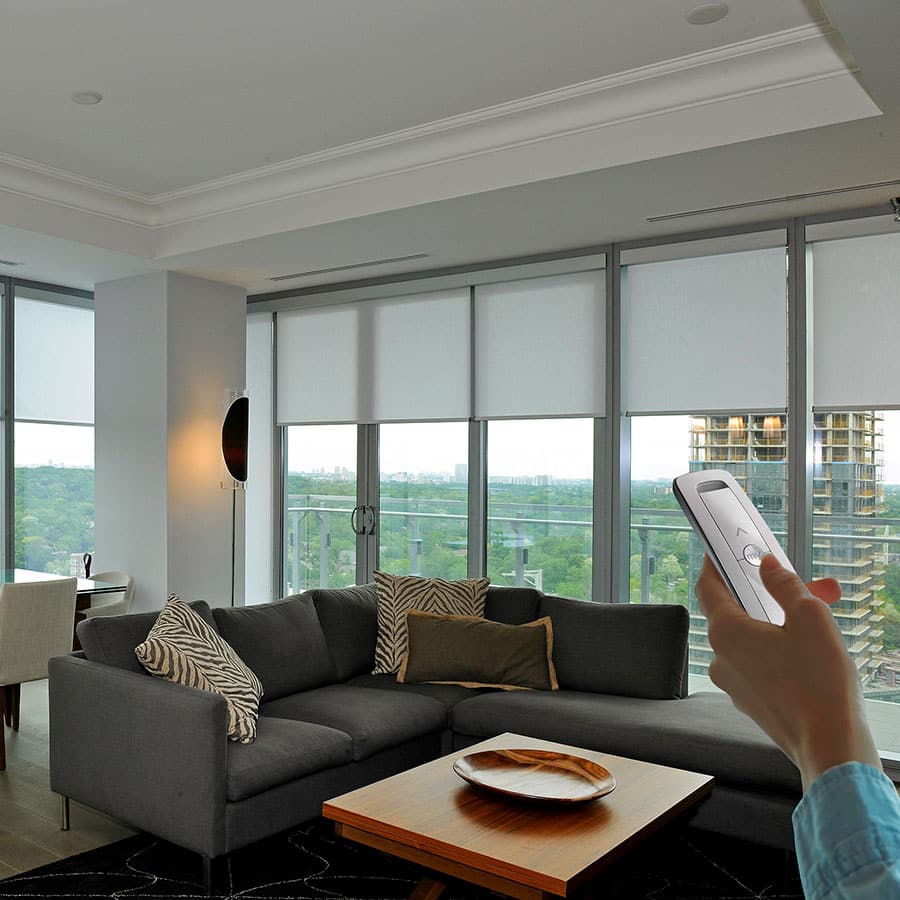
- Motorization. Motorized shades put no operating hardware on the window at all. Sun Glow supplies Stealth and Somfy motors, controlled by remote, app or voice, with a solar recharging option on Stealth.
The full range of operating control options and the child safety guide cover selection in more detail.
Why this article does not tell you that any particular product complies. Compliance is a property of a specific product configuration, verified by testing against ss. 2–15, and documented by the party that manufactured or imported it. It is not a property of a brand, and section 9 restricts how it can be talked about in product advertising in the first place. Ask for the test evidence on the exact configuration you are supplying — including from us.
A Compliance Check You Can Run on Any Supplier
Nine questions. A supplier who answers all nine without a follow-up email has a compliance function. One who cannot is a supplier whose product you are personally advertising and selling under section 8.
| Check | What a straight answer looks like |
|---|---|
| Which configurations were tested? | Named product families and control types, not “our products” |
| Tested against what? | Sections 2 to 8 of SOR/2019-97, with the 35 N and 90 N forces applied |
| By whom, and when? | A named lab and a date, with a report you can be sent |
| Bilingual information? | English and French, meeting the s. 10–12 legibility and type-height rules |
| Model and date of manufacture? | On the product and on the package, per s. 13 of the Regulations |
| Instructions supplied? | Assembly, installation and operation, per s. 14 |
| Warning statement? | Present on product, package, instructions and advertising, per s. 15 |
| Marketing copy reviewed? | No direct or indirect reference to the Act or the Regulations, per s. 9 |
| Traceability? | Records of who supplied it and who it went to, kept six years |
Run the same nine on your own operation. Most gaps in the trade are not in the product — they are in the carton label, the instruction sheet and the website copy.
Frequently Asked Questions
Are corded blinds illegal in Canada?
No. Cords are restricted, not banned. A corded window covering supplied in Canada must keep reachable cords to 22 cm or less and reachable loops to a 44 cm perimeter or less, and must carry the required information and warning. A product that meets those limits is lawful to sell.
What is the maximum blind cord length in Canada?
22 cm for a reachable cord, measured under a gradually applied pull force of 35 N. Loops formed by a reachable cord are limited to a 44 cm perimeter under the same force.
Do the rules apply to blinds already installed in homes?
The Act prohibits manufacturing, importing, advertising and selling non-compliant product. It does not make possession an offence, so coverings installed before May 1, 2021 need not be removed under this regulation. Replacing them is a safety decision, not a compliance obligation.
Can I still sell corded blinds commercially?
Yes, within the limits. Product supplied exclusively to commercial entities for commercial purposes, never made available to consumers, sits outside the consumer-product definition — but multi-unit residential is a home, whoever signs the purchase order.
What is the penalty for selling non-compliant blinds?
Under section 41 of the Canada Consumer Product Safety Act, a summary conviction carries a fine of up to $250,000 or six months’ imprisonment, or both — $500,000 and 18 months for a subsequent offence. On indictment the maximum is $5,000,000 or two years, or both. In practice the commercial damage arrives first: a recall, a stop sale or a stop distribution.
Do US-compliant products meet Canadian rules?
Not automatically. The two countries’ requirements are separate instruments with different thresholds, test methods and labelling rules, and the Canadian information requirements are bilingual. Treat a US certificate as evidence of nothing here until you have seen testing against SOR/2019-97 itself.
Where This Leaves You
Compliance is not bought once. It is a property of a supply chain, and it fails at whichever link has the weakest paperwork — usually the labelling, not the hardware. In multi-unit residential, replacement programs are where the old-stock question surfaces; resolve it before a turnover does.
Compliance starts at the factory. If your current supplier cannot produce the test evidence, the bilingual labelling and the traceability records on request, talk to one that can. Partner with Sun Glow