A tenant gives notice, the suite turns in three weeks, and the blinds in the living room are bent, stained or missing a chain. Somebody orders whatever is available, at whatever price the nearest supplier quotes, and the building ends up with one more window that matches nothing around it. A window covering replacement program replaces that cycle with a standing spec, a known supplier and a predictable budget line.
This guide is for residential property managers, condo corporation boards, REIT facility teams and student-housing operators who replace coverings continuously across a portfolio. It covers what ad-hoc replacement really costs, how to set one spec per suite type, where the cord-safety regulations actually bite, how to fit orders into turn schedules, and what to agree with a manufacturer before the first order goes in.
The Cost of Ad-Hoc Replacement
Ad-hoc replacement rarely looks expensive on any single invoice. The cost sits in everything around the invoice: a fresh quote every time, a different product depending on who picked up the phone, and staff time spent chasing measurements, approvals and installers for one window at a time.
Then there is the building itself. A façade where every third window shows a different fabric colour or valance tells prospective tenants the property is maintained piecemeal. Mismatched hardware also means mismatched parts, so a broken chain or bracket in one suite cannot be fixed with stock from the last one.
| Cost driver | Ad-hoc replacement | Replacement program |
|---|---|---|
| Pricing | Quoted per order, usually at one-off rates | Agreed once for the standard specs, applied to every order |
| Admin per suite turn | Measure, quote, approve, schedule — every time | Order the suite type’s standard against the measurements on record |
| Product consistency | Whatever was available that week | Same product, fabric and colour per window type |
| Repairs and parts | Mixed systems, mixed parts | One system, interchangeable components |
| Budgeting | Reactive, hard to forecast | Forecastable from turnover rates and suite counts |
Put your own numbers on it. Pull the last twelve months of window covering invoices for one building, count the suppliers and distinct products involved, and add an honest estimate of staff hours per replacement. That figure is the baseline a program has to beat — and it is usually more persuasive to a board than any supplier’s claim.
Standardization: One Spec Per Suite Type
The core of any program is a written standard: for each window type in each suite layout, one product, one fabric, one colour, one valance and one operating system. Once that standard exists, ordering becomes a lookup rather than a decision, warranty and repair conversations refer to a known configuration, and the building reads as one property from the street.
The standard does not have to be identical across every room. A common split is a light-filtering or sunscreen fabric in living areas and blackout in bedrooms. Sun Glow’s work on a new McMaster University residence in Hamilton used exactly that pairing — sunscreen fabric to manage glare and heat while keeping daylight, blackout where students needed darkness to sleep.
| Spec field | Why it gets fixed in the standard | Example from a Sun Glow multi-unit project |
|---|---|---|
| Product system | Determines parts, repairs and operating feel | Vision roller shades at Highgate Residences of Ancaster |
| Fabric and colour | Drives appearance, light control and reorder accuracy | CS 103 in Brown (Highgate); CS 103 in White (Gardens of Ingersoll) |
| Exterior-facing appearance | Keeps the façade uniform regardless of suite | Colour-coordinated fabrics facing outward at City of Toronto supportive housing |
| Valance | Affects mounting depth and finished look | 3″ fascia in white (Toronto supportive housing); 3″ square fascia (Gardens of Ingersoll) |
| Operating system | Sets the child-safety position for the suite | Safety Shield with stainless steel chain on all three projects above |
| Mount | Inside or outside, per window type | Recorded per suite type from the original measure |
More project examples from apartments, student residences and senior living are on the residential projects page.
The Cord-Compliance Question
Older buildings carry older stock, and that raises a fair question from boards and owners: does every corded blind in the portfolio have to come out? The short answer is no — but the details matter for how a program handles replacements.
Canada’s corded window covering regulations (SOR/2019-97) came into force on May 1, 2021. They regulate supply — manufacturing, importing, advertising and selling — not possession. A property manager is not required by the regulation to remove coverings installed before that date. Replacing them is a safety decision, not a compliance obligation.
New supply is a different matter. Multi-unit residential housing counts as a home, whoever signs the purchase order, so product supplied for suites should be treated as in scope. And re-supplying old corded stock — through a clearance sale, a donation or a second-hand channel — is itself a supply event, not a disposal.
Compliance risk, stated plainly. Compliance is a property of a specific product configuration, verified by testing and documented by whoever manufactured or imported it. It is not a property of a brand. Ask any supplier, including us, for the test evidence on the exact configuration going into your suites — and treat this section as a summary, not legal advice.
For the replacement cycle itself, the practical strategy is to retire corded product at suite turn rather than all at once. Sun Glow’s child-safe options cover the main routes:
- Safety Shield adds a protective barrier over the chain on existing shades.
- NEO Chainless System removes cords and chains entirely; the shade is pulled down by hand and retracts on a light tug.
- Zero Gravity shades operate with no cords or chains and hold position with a touch.
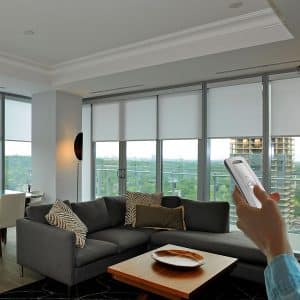
- Motorized shades take the operating hardware off the window, controlled by remote or app.
Suite-Turn Logistics
The move-out to move-in window is the constraint every program has to respect. The single biggest improvement is timing: place the order when notice is given, not when the suite is empty. With a standard on file, there is nothing to decide at that point — only a quantity to confirm.
- Notice received. Pull the suite type’s standard and the measurements on record.
- Order placed. Confirm quantities and any suite-specific exceptions.
- Production. Shades are made to order.
- Install at turnover. Old coverings come down and new ones go up during the same work window as paint and cleaning.
Measuring is where programs quietly fail. Same floor plan does not guarantee identical openings, especially in older buildings. Measure once per suite type to set the standard, then spot-check individual openings. Sun Glow’s measuring guide sets the basics your team or installer should follow: a steel tape rather than a fabric one, measurements to the nearest 1/16 inch, and the narrowest of three width readings for inside mounts.
Where production happens matters too. Sun Glow is a Canadian manufacturer, making custom shades to order in Toronto since 1983, so a reorder is not waiting on offshore supply. Production times vary with the order and the season, so confirm current timelines when you set the program up and build them into your turn schedule rather than assuming a number.
Structuring a Window Covering Replacement Program With a Manufacturer
A program is an agreement about how ordering works, not just a price list. Before the first order, settle these points:
- Standing specs on file. The suite-type standards above, held by the supplier as well as by you, so an order can reference a suite type rather than restating every detail.
- Volume structure. An annual estimate built from suite counts and turnover rates, with pricing tied to the standard specs rather than to each order.
- Warranty flow. Who reports a failure, who inspects it, and how replacements are ordered — simpler when every suite runs the same configuration.
- Service coverage. Who installs, repairs and maintains across every building in the portfolio.
- Budget support. A forecast the board or asset manager can put into the annual budget instead of absorbing surprises.
That last point carries extra weight for condominiums, where boards approve budgets annually. For Ontario condo managers, ACMO — the professional association for condominium management — is a useful reference point for professional condo management practice in the province.
Sun Glow’s multi-unit building programs are built around the same idea: consistent product across every location, installation, maintenance and repairs handled through one call, and a single provider instead of a different contractor in every region.
Already know your suite types? Bring the list of layouts and window counts to a first conversation and we will work through a standard spec for each one.
Every suite turn shouldn’t be a procurement project. Book a consultation and we’ll build a spec standard your team can order against.
Book a Consultation
Frequently Asked Questions
How do property managers buy blinds in bulk?
Through a window covering replacement program rather than individual purchases: a written standard per suite type, a forecast of annual volume from turnover rates, and per-suite orders placed against that standard. Pricing, warranty handling and service are agreed once rather than renegotiated with every order.
Should rentals have cordless blinds?
Existing corded coverings installed before May 1, 2021 do not have to be removed under SOR/2019-97. New product supplied into residential suites is in scope of the regulation, and cordless, chainless or motorized operation removes the cord question entirely. A program can make that switch one suite at a time, as each unit turns over.
How fast can replacement blinds ship for a suite turnover?
It depends on the product, the order and the production schedule at the time, so confirm current timelines with your supplier when you set up the program. The more reliable lever is order timing: with specs on file, the order can go in when notice is given rather than after the suite is empty.
Who pays for blinds in condos — the corporation or the owner?
It varies. Responsibility depends on the condominium’s declaration and by-laws, and on what is treated as part of the unit versus the common elements. Check the governing documents with the corporation’s manager or legal counsel before building blinds into a corporation-funded program.
How do you standardize blinds across a building?
Fix one product, fabric, colour, valance and operating system per window type, record it against each suite layout, and order only against that record. Keep the outward-facing colour consistent even where interior choices differ, so the façade stays uniform.
Ready to replace the next suite without starting from scratch? Start a program conversation with Sun Glow.