
Most dealers do not change suppliers because a price list improved. They change because a remake dragged on, an install date slipped, and a client stopped returning calls. Sourcing wholesale custom blinds in Canada is a decision about operations first and unit cost second — and the four channels available to you fail in very different ways.
This compares those four channels, and ends with a ten-point scorecard you can run against any supplier, including this one.
The Four Ways Dealers Source Custom Blinds
Custom window coverings reach a dealer through four channels. What separates them is not product quality — it is who your counterparty is when something goes wrong, and how many parties sit between you and the person who can actually fix it.
Manufacturer-Direct
You buy from the company that builds the product. Specification questions, tolerance questions, hardware substitutions and remake decisions all resolve at a single counterparty, and that counterparty owns the production schedule. The trade-off is range: a manufacturer sells its own catalogue, so a dealer carrying unrelated categories may need more than one relationship.
National Distributor
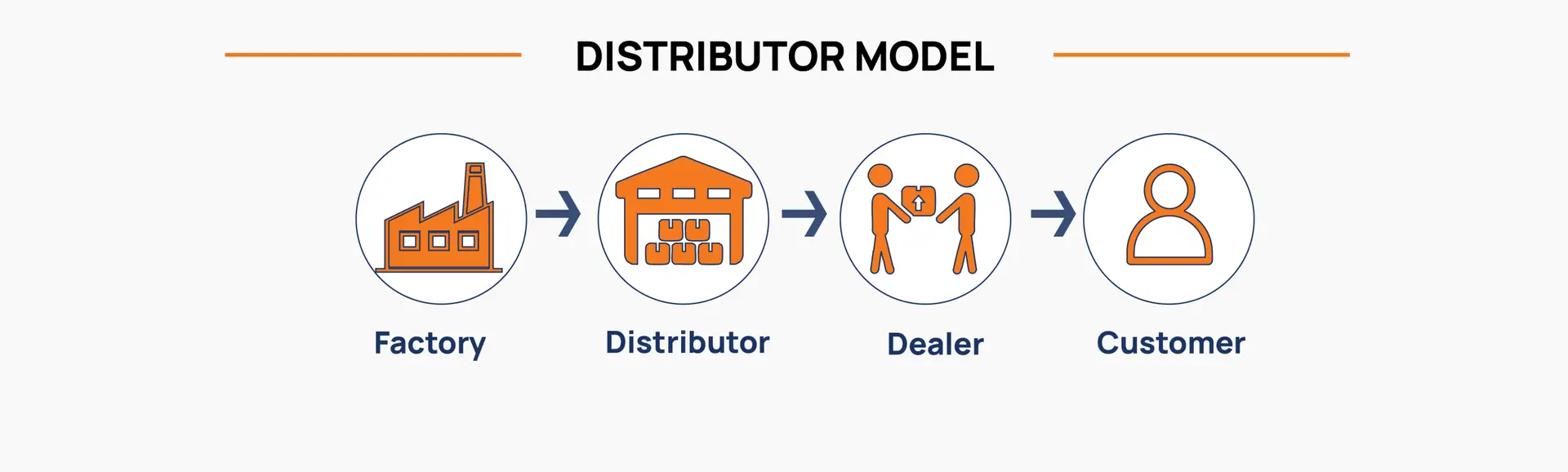
A distributor aggregates multiple manufacturers into one account, one invoice and one sales rep. For a dealer who needs breadth more than depth — blinds, shutters, drapery hardware, all on one PO — that consolidation is real value. The cost is a layer: the distributor buys at one price and sells at another, and technical or remake questions travel through them to the factory and back.
Big-Box Trade Desk
Large retailers run trade programs for contractors and designers, usually with account terms and store-level pickup. They work for occasional, straightforward orders, particularly when a job already has materials moving through that retailer. They are weaker where custom work lives: unusual sizes, fabric substitutions, commercial specification, and anything requiring a conversation with someone who knows the product line rather than the SKU.
Offshore Import
Direct import can deliver the lowest landed unit cost at volume, and for dealers with the capital to buy ahead it is a legitimate model. What comes with it is exposure — ocean freight, customs clearance, currency movement, and a remake process measured in shipping cycles rather than production days. Container freight rates hit an 18-month high in the second quarter of 2026, according to TradeBeyond’s Q3 2026 retail sourcing report, a reminder that landed cost is not a fixed input.
| Channel | Your counterparty | Margin layers | Technical questions | Remake ownership | Border & currency exposure |
|---|---|---|---|---|---|
| Manufacturer-direct | The factory | One | Answered by the people who build it | Factory owns it end to end | None, if the factory is domestic |
| National distributor | The distributor | Two | Relayed to the manufacturer | Shared — distributor files, factory produces | Depends on where the goods originate |
| Big-box trade desk | The retailer | Two or more | Handled at retail service level | Governed by retail return policy | Usually absorbed by the retailer |
| Offshore import | An overseas factory or agent | One, plus freight and duty | Across time zones and languages | Yours to absorb or reship | Full — freight, customs, FX |
What Manufacturer-Direct Actually Changes
Shortening the chain changes three things that show up in a dealer’s P&L, none of which appear on a price list.
The first is margin structure. Every intermediary between the factory and your customer has to earn its keep, and it earns it out of the spread. Fewer layers does not automatically mean a lower price — a distributor buying in volume can be competitive — but it does mean fewer parties whose margin requirements are built into your cost.
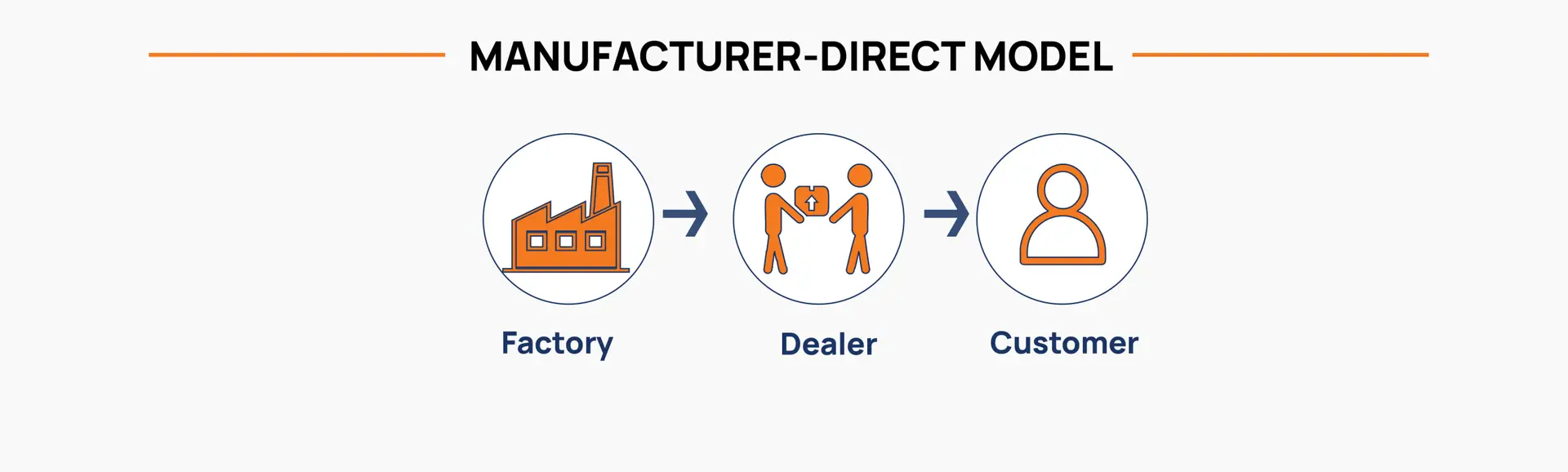
The second is the quality of the technical answer. When a dealer asks whether a fabric will hold a given width without deflection, or which control system suits a commercial job with a specific mounting condition, the accurate answer comes from the people who engineer and assemble the product. Relayed answers arrive slower and lose detail in transit.
The third is remake ownership. A remake is a production job, and only the factory can schedule production. When the factory is also your counterparty, the diagnosis and the re-cut happen inside one organisation rather than across a claim process. It is the largest hidden cost in a supplier relationship, and the one most often underweighted when comparing quotes.
Lead Times and Why They Decide Jobs
Dealers rarely lose a job on price alone. They lose it on the install date — the one the client already booked the painter around, or the one the general contractor built into the turnover schedule. A supplier who is cheaper and late costs more than a supplier who is dearer and predictable.
Geography is the largest variable in that predictability. Domestic production removes customs clearance, border transit and exchange-rate timing from the schedule entirely. Cross-border and offshore supply add steps that are outside both your control and your supplier’s, which is why import lead times are usually quoted as ranges rather than dates.
Sun Glow has manufactured in Toronto since 1983, operating from Hollinger Road as a Canadian manufacturer of custom window treatments. For a Canadian dealer, that means the production schedule and the delivery schedule sit in the same country as the job site. Ask any supplier — including this one — for their current production window in writing before you quote a date to a client.
Domestic supply is also becoming a selling point rather than just an operational one. CIRA’s Canadian Internet Trends 2026 report, published in July 2026, found 65% of Canadians prefer buying from Canadian retailers when given the choice. That preference travels up the chain: a dealer who can say the product is made in Canada has an argument the import channel cannot match.
How Dealer Pricing Works for Wholesale Custom Blinds in Canada
Trade pricing in this industry is structural, not published, and the structure is worth understanding before you negotiate.
Wholesale pricing exists so the dealer sets the retail number. You are not reselling at a fixed price with a fixed points spread — you build your own pricing around your market, your measuring and install labour, your service commitments and your competitive position. Two dealers buying identically can run very different gross margins depending on how they package the work.
Tiers generally reflect annual volume, order consistency and the level of service the supplier provides. What is negotiable is usually not the base rate but the terms around it: freight thresholds, sample and display support, payment terms, and how remakes are treated. Ask about those explicitly — they are where a program is genuinely differentiated.
Sun Glow provides dealer pricing and custom quoting through its dealer program rather than publishing rates, which is standard for made-to-order product. If you are evaluating suppliers, request Sun Glow dealer pricing and compare it against the structure above rather than against a single unit cost.
A Sun Glow dealer account includes:
- Wholesale pricing and custom quotes
- Product catalogues, sample books and openness samples
- Dealer Portal access with built-in quoting and order verification
- Showroom displays and turnkey marketing kits
- Product, installation and automation training
- Technical and commercial specification support
Request dealer pricing and compare against your current supplier.
Support Beyond Price
Two suppliers with the same cost sheet can produce very different years for a dealer. The difference is what arrives with the product.
The Sun Glow dealer program supplies the client-facing material as well: the fabric collection, showroom-ready displays and the product magazine dealers use in selection appointments.
Training is delivered in house and on demand: sessions covering product knowledge, installation technique and automation systems, backed by video tutorials and specialists available by phone or on site. For commercial work, the program covers LEED point contribution, automation systems and quoting tactics — the material a dealer needs when the buyer is a spec writer rather than a homeowner.
Ordering runs through the online Dealer Portal with a built-in quoting tool and automatic order verification against product specifications. That verification step matters more than it sounds: catching an impossible size or an incompatible control combination at order entry is a remake that never happens — a real gap versus suppliers still taking orders by emailed PDF or fax.
The catalogue behind it is custom roller shade manufacturing plus zebra, sheer, cellular, skylight, exterior and panel-track systems, with control options from manual chain through chainless lift assist to full motorisation. Sun Glow also supplies components — tubes, clutches, automation parts and fabrics — to other manufacturers, a fair proxy for how the hardware is regarded in the trade.
Choosing: A 10-Point Supplier Scorecard
Run this against every supplier you are considering, and against the one you already use. The pattern matters more than any single answer.
| # | Criterion | The question to ask |
|---|---|---|
| 1 | Manufacturing location | Where is the product actually built, and does that add a border to my schedule? |
| 2 | Production window | What is your current lead time in writing, and how has it moved in the last six months? |
| 3 | Remake ownership | Who diagnoses a remake, who pays for it, and how does it enter the production queue? |
| 4 | Technical access | Can I reach someone who knows the engineering, not just the order status? |
| 5 | Pricing structure | How are tiers set, what moves between them, and what is negotiable besides the base rate? |
| 6 | Ordering system | Is there a portal with quoting and order verification, or is this email and PDFs? |
| 7 | Samples and display | What sample and showroom support comes with the account, and at what cost? |
| 8 | Training | Is training ongoing and hands-on, or a one-time onboarding call? |
| 9 | Commercial support | Will you help with specification, submittals and larger project requirements? |
| 10 | Supply-chain exposure | What in this relationship is exposed to freight rates, customs or currency? |
A supplier who answers all ten without hedging has thought about the dealer’s side of the relationship. One who deflects on remakes and lead times has told you what your next difficult month looks like.
Frequently Asked Questions
Is it cheaper to buy blinds direct from the manufacturer?
Often, but not always — a distributor buying in large volume can be price-competitive on individual lines. The more reliable advantage of buying direct is fewer margin layers and a single counterparty for technical questions and remakes, which shows up in operating cost rather than unit cost.
What is a typical wholesale discount on custom blinds?
There is no meaningful industry-wide number: custom product is priced per configuration, not off a fixed list. Dealer pricing is tiered by volume and consistency, and the terms attached to a tier — freight, samples, remake handling — often matter more than the base rate. Request pricing from each supplier on the same specification.
How fast can wholesale custom blinds ship in Canada?
It depends on the manufacturer and the configuration; a supplier quoting a single universal figure is guessing. Domestic production removes customs and border transit from the timeline, which is why Canadian-made orders are generally quoted with more schedule confidence than imported ones. Ask for a current, written production window before committing to an install date.
Do wholesale suppliers handle remakes?
Most do, but the process differs sharply. With a manufacturer-direct relationship the factory diagnoses and rebuilds. Through a distributor or retail trade desk, the claim is filed with the intermediary and produced by the factory, which adds handoffs. With imported product, a remake usually means a new shipment. Get the remake policy in writing before your first order.
Can dealers buy without a storefront?
Yes. Trade programs are commonly open to installers, designers, contractors and in-home consultants, not only businesses with a showroom. Suppliers typically ask for business documentation rather than a retail location. If you are considering the move, see how to become a window covering dealer for what setting up actually involves.
Get Sun Glow Dealer Pricing
If your current supplier is costing you installs, get Sun Glow’s dealer pricing and current lead-time information — manufactured in Toronto since 1983, with dealer support built around the way the trade actually works. Request dealer pricing.