On most projects, the power strategy for commercial motorized shades is settled before anyone has looked closely at the shades. If nobody puts low-voltage runs, panel locations and control wiring on the electrical drawings before rough-in, the option is gone once the drywall goes up. What’s left is whatever the finished walls allow. That choice drives install cost, maintenance load and how the shades talk to the rest of the building for as long as they hang.
This guide compares the three ways to power motorized shades at commercial scale — wired, Power over Ethernet and battery — for electrical and AV designers, architects, general contractors and facility managers. It covers how each works, what each one asks of the electrical design, where each fits, and a coordination checklist for locking the decision in at design stage. Where Sun Glow’s own systems fit, we say so; where they don’t, we say that too.
Why Power Strategy Comes First
A motorized shade is a small electrical load at the head of every window. Whether that load is fed by a cable, a network port or a battery decides which trades are involved, when they need information, and what the building looks like when it is finished.
The window for choosing is narrow. Sun Glow’s motorization guide is direct about it: on new builds, the motorization decision has to come before wiring and insulation, and shades cannot be motorized after purchase because the motor is specified with the shade when it is ordered. Miss the rough-in and wired options become surface raceway or nothing, leaving battery as the default rather than the choice.
- Schematic design: identify which openings are motorized and the likely power approach for each zone.
- Design development: fix panel or switch locations, control protocol and the shade schedule.
- Construction documents: put low-voltage runs, network drops or line-voltage feeds on the electrical drawings.
- Rough-in: cabling goes in. After this, changing strategy means opening finished walls.
- Shade order and commissioning: motors ship with the shades, then get programmed, grouped and handed over.
Option 1: Wired (Low-Voltage DC or Line-Voltage)
Wired systems give each motor a permanent power feed, so there is never a battery to charge. There are two flavours. Line-voltage motors take AC power directly at the window. Low-voltage DC systems run power from a central panel to each motor, keeping line voltage out of the window head.
How Sun Glow does low-voltage DC
Sun Glow’s Stealth Flex motor accepts DC power from an adapter, an external battery or a DC distribution panel. The motorization guide gives the panel’s numbers:
- It takes 85–125 V AC in through an IEC-C14 inlet and outputs low-voltage DC, rated 360 W and 24 A across the panel and 1.33 A per channel.
- One panel powers up to 18 DC motors. Larger 35–45 mm motors take two channels each.
- Cable gauge steps up with run length, from 24 AWG on runs up to 15 m to 16 AWG at 100–160 m. Beyond roughly 165 m, a second panel is needed.
For line-voltage and 12 V or 24 V DC motors, Sun Glow also supplies Somfy, which the guide lists across battery, low-voltage DC and AC line-voltage options. See our Somfy motorization page.
Cost logic and coordination
Wired systems shift cost from the motor to the building. You pay for cable runs, panel or circuit capacity and electrical labour at rough-in. You don’t pay for charging labour over the life of the building. That trade makes most sense where openings are numerous, high or hard to reach, and where walls are open anyway.
The electrical engineer needs three things early: which openings are motorized, where the panel or feeds sit, and the run details to each opening. The motorization guide lists exactly these as what an electrician needs. Best fit: new construction, major renovations with open ceilings, large spans and high openings.
Option 2: PoE Shading
Power over Ethernet delivers power and control to each motor over a single network cable from a PoE switch. Somfy’s Sonesse 30 PoE and Sonesse 40 PoE motors are examples. According to CE Pro’s coverage of the Sonesse 40 PoE launch, one Cat-5e or Cat-6 cable carries power, data and control. The same coverage cites the IEEE 802.3bt PoE standard and describes integration with third-party control systems through an API.
The appeal is convergence. Shades become network endpoints alongside cameras, access control and lighting, so the IT or AV designer owns them in the same drawings. Each motor reports and is addressed individually, and there are no batteries anywhere in the system.
How a PoE shading system is laid out
- PoE switch in the telecom room, sized for the total power budget of every motor it feeds.
- Structured cabling, one Cat-5e or Cat-6 run from the switch to each motor, carrying power and data together.
- PoE motors at each opening, each addressable on the network.
- Control layer — a third-party control system or configuration software that talks to the motors over IP.
Compared with a DC panel layout, the topology is the same star shape. What changes is the trade that owns it. The telecom contractor pulls the cable, and the network team configures the endpoints.
Where PoE asks more of the design
- Switch power budget. Every motor draws from the switch’s PoE budget, so the switch has to be sized for simultaneous movement, not idle draw.
- Cable distance. Ethernet runs are limited in length, so telecom room locations matter on large floor plates.
- Ownership. Shades now depend on network uptime and IT change control. Agree who owns the network side before handover.
PoE shines in buildings already designed around a converged IP network. It is overkill for a handful of offices or a retrofit without structured cabling.
Where Sun Glow stands on PoE. Our motorization guide does not currently list PoE motors among the options we supply. If your project’s IT or AV design is PoE-first, raise it at the consultation stage and we will confirm what can be supplied, rather than you assuming it from this article.
Option 3: Battery Motors at Scale
Battery motors need no wiring at all. Sun Glow’s Stealth Rechargeable carries a built-in battery charged by USB-C. The Stealth product page rates a full charge at up to six months, and an optional solar panel can keep it topped up. The motorization guide specifies one Stealth solar panel per motor, which only makes sense on a window that gets direct sun for part of the day. The Stealth Wand is battery-powered and recharged by USB-C as well.
For a retrofit, battery is often the right answer outright. It means no wall chases, no electrical permit work in occupied space, and installation that can follow the tenant schedule floor by floor. Recommending it where it fits, even though it is the lightest install, is part of giving honest advice.
Charging logistics, by the arithmetic. “Up to six months” is a best case, and actual intervals depend on usage, shade size and conditions. Even at that best case, every motor needs charging at least twice a year. On a 200-window building, that is 400 charging events a year before any motor falls short of the rated interval. Someone has to own that task, the route and the ladder access. Where nobody will, battery is the wrong choice, however clean the install.
Battery and wired are not mutually exclusive within the Stealth family. The Stealth Flex motor runs on an external battery, a DC adapter or a DC distribution panel, so the same motor can serve a battery zone and a wired zone on one project. Our Stealth motorized shade systems page lists the full motor line-up and control accessories.
Best fit: retrofits, finished spaces, occupied buildings, accessible windows, and small motorized counts within a larger manual project.
Commercial Motorized Shades: The Comparison Table
| Wired (DC or line-voltage) | PoE | Battery | |
|---|---|---|---|
| Relative upfront cost | Higher: cabling, panels, electrical labour | Higher: network drops and PoE switch capacity | Lowest install cost |
| Decided by | Before rough-in | Before rough-in, with IT/AV design | Any time before the shade order |
| Ongoing maintenance | No charging | No charging; depends on network uptime | Recharge every motor periodically |
| Control options | Remote, app, keypads; BMS through Somfy interfaces | Network control and third-party integration | Remote, app, voice |
| Best fit | New builds, large spans, high openings | Converged-network buildings | Retrofits, finished and occupied spaces |
Not sure which column your project belongs in? Book a consultation and we’ll work through the options against your window schedule.
Book a Consultation
Controls and Integration Preview
Control spans a spectrum, from a handheld remote to a full building management system. Which end you need narrows the motor choice.
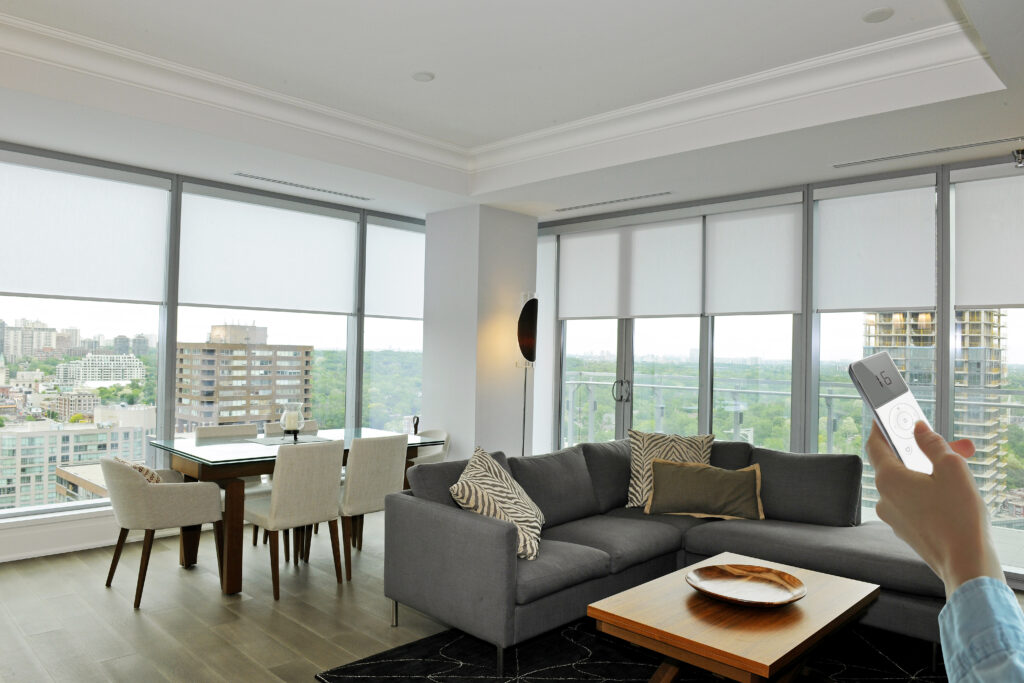
- Stealth: Zigbee 3.0 motors controlled by remote, wall-mountable 16-channel pad, the Smart Life app (with Wi-Fi through the Stealth Bridge) and voice through Amazon Alexa, Google Home and IFTTT. The motorization guide is clear that Stealth has no wired wall-switch control and no BMS path.
- Somfy: adds dry-contact and digital keypads, paddle switches and sun sensors. For building automation, the guide lists Somfy Connect UAI Plus, LTI and BMS interfaces plus SDN data hubs.
The guide’s own rule of thumb is a useful starting point. Choose Stealth where there is no existing automation platform. Choose Somfy for an existing Somfy ecosystem or any wired or BMS requirement. Confirm protocol compatibility with the specific BMS before it goes into the spec, not after.
Specifying Motorization: Coordination Checklist
Lock these down at design stage, and put them in writing:
- Motorized openings. Mark which openings are motorized on the shade schedule, with width, drop and fabric for each. Oversized openings need all three before a motor can be confirmed. The guide notes there is no single maximum width.
- Power approach per zone. Wired, PoE or battery, decided zone by zone rather than building-wide by default.
- Power locations. DC panel positions, line-voltage feeds or network drops, shown on the electrical drawings.
- Cable runs. Lengths and gauges for low-voltage DC, checked against the panel limits.
- Control protocol and interface. Remote, app, keypad or BMS, and which interface hardware connects them.
- Groups and scenes. Which shades move together, by façade, floor or room.
- Charging plan. For battery zones, who charges, how often and with what access.
- Commissioning responsibility. One named party for programming, grouping and handover, so a fault isn’t passed between the electrician, the integrator and the shade installer.
Have a window schedule already? Send it with your power assumptions, and we’ll review motor and power options against it before the electrical drawings close.
You can see both families on real projects on our commercial shading projects page. Queen Richmond Centre used automated light shelves and Somfy automation on a building targeting LEED Gold. The Centre for Social Innovation ran Somfy automation with EVT fabric, and Ace Offices in East York used Stealth automation.
Frequently Asked Questions
How much more do motorized commercial shades cost?
It depends on the power strategy more than on the motor. Wired and PoE systems add cabling, panel or switch capacity and labour at rough-in. Battery systems have the lowest install cost but add recurring charging labour. Compare whole-life cost per opening, not motor price alone.
What is PoE shading?
PoE shading powers and controls each shade motor over a single Ethernet cable from a PoE network switch, under the IEEE 802.3 PoE standards. It suits buildings designed around a converged IP network. Sun Glow’s motorization guide does not currently list PoE motors, so confirm availability for your project.
How long do battery shade motors last in commercial use?
Sun Glow rates a full charge of the Stealth Rechargeable at up to six months. Real intervals vary with how often shades move, their size and conditions, so plan for at least two charges per motor per year. Overall motor service life depends on duty cycle, so ask for the manufacturer’s rating for your configuration.
When must motorized shade wiring be decided?
Before rough-in. On new builds the motorization decision has to precede wiring and insulation. After that, wired and PoE options generally mean opening finished walls.
Can motorized shades connect to a BMS?
Yes, with the right motor family. Somfy offers BMS interfaces, including Somfy Connect UAI Plus, LTI and SDN data hubs. Sun Glow’s Stealth line has no BMS path, so specify Somfy where BMS integration is required, and confirm protocol compatibility with the BMS vendor.
Pick the power strategy before the drywall picks it for you. Book a consultation and we’ll map wired, PoE and battery options to your actual window schedule.