A guest who wakes at 5:40 a.m. to a blade of daylight down the side of the shade does not write a review about the window. They write about the room, the sleep and the brand. Hotel window treatments have become an operating line that shows up in guest scores, flag audits and housekeeping budgets, and the decisions that matter are made at specification, long before anyone picks a fabric colour.
This guide is for owners and GMs, FF&E procurement, hospitality designers and renovation project managers: blackout as a system, layering, durability, phasing and the documentation a brand audit asks for.
Why Guest Room Blackout Is a Revenue Issue
Sleep is the product a hotel room sells, and darkness is one of the few sleep variables the property fully controls.
J.D. Power’s 2019 North America Hotel Guest Satisfaction Index Study put a number on it. Guests who reported a better-than-expected sleep experience gave overall satisfaction scores 114 points higher on a 1,000-point scale, and 78 percent of them said they “definitely will” return to the property. Only 29 percent of guests reported that experience. That gap is the opportunity (LODGING, July 2019).
Light is the sleep variable guests describe most specifically, and the complaint repeats across reviews of the same room type because the cause is built into the window. Brand standards commonly address guest room light control, and an inspector standing in a darkened room at midday will see a perimeter light leak in seconds.
Fabric alone fails the audit. The gaps around the fabric are what the inspector sees.
True Blackout: Fabric vs. System
An opaque fabric stops light passing through the shade. It does nothing about light passing around it.
Every roller shade has three paths for light that never touch the fabric. On an inside mount, the fabric is cut narrower than the opening so it can roll freely, which leaves a gap down each side. At the top, the roll itself and its brackets leave a gap between the fabric and the head of the window. At the bottom, the hem bar rarely seals perfectly against the sill. A blackout fabric with all three paths open still lets in enough light to read by, and in a dark room the eye goes straight to those bright lines.
Closing those paths is hardware work, and that is where hospitality blackout is won or lost.
The sides: channels
Side channels capture the fabric edge so there is no open gap down the jamb. Sun Glow’s engineered blackout shade systems come in two profiles. L Channels are a right-angle profile that reduces side light gaps, works with all shade types and bottom bars, and can be retrofitted to existing shades. U Channels enclose the fabric edge and are rated on the product page to block 99% of sunlight. They come in anodized, white or black aluminum and work with both chain-operated and motorized shades.
Channels can be ordered as sides only, or as side and bottom channels for complete light blocking. For guest rooms that have to pass a blackout audit, specify the bottom channel too. The sill line is the gap most often left open.
The top: cassette or fascia
Sun Glow’s own guidance on side channels is direct: for best results, use fascia or a cassette to prevent light entering above the shade. The roller shade range offers a Curved Cassette, a Compact Curved Cassette and a Square Cassette, plus 3″ and 4″ Square Fascia, all in aluminum. Fascia can be wrapped in the shade fabric so the head reads as one surface.
Where the ceiling design allows, a recessed pocket hides the roll completely. Sun Glow’s Hanger & Closure system mounts inside pockets of 4″ to 5″ or larger, uses commercial-grade aluminum, and has a removable bottom enclosure so housekeeping or maintenance can reach the shade without opening the ceiling. Pockets have to be drawn early. They are a drywall detail, not a window treatment add-on.
The bottom: hem and sill
With a bottom channel specified, the hem bar seats into a profile instead of hovering above the sill. Without one, the sill condition decides how much light gets under the shade. Check it at the model room, not on the first occupied floor.
Specify the system, not the fabricA guest room schedule that says only “blackout roller shade” leaves the light gaps to whoever installs it. Write the side channel profile, the bottom channel and the head treatment into the schedule for every guest room window type.
The Layered Guest Room Approach
Guests want two different rooms: a bright one during the day and a dark one at night. One layer rarely does both well.
The traditional answer is a blackout layer behind a sheer or drapery: two separate systems, each with its own hardware.
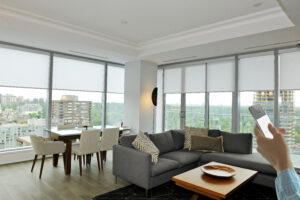
A dual shade puts both layers in one headrail. Sun Glow’s Dual Shades carry two independently operated fabrics behind one Dual Square Fascia: a light-filtering or sunscreen fabric for daytime view and glare control, and a blackout fabric for sleep. Fabric options include roller, Interlude and Illusions, and operation can be manual or motorized. The same approach is in use on Sun Glow’s institutional projects. At Gore Meadows, dual shades let an opaque fabric be lowered when room darkening is needed, with a 5% sunscreen for outward visibility the rest of the time.
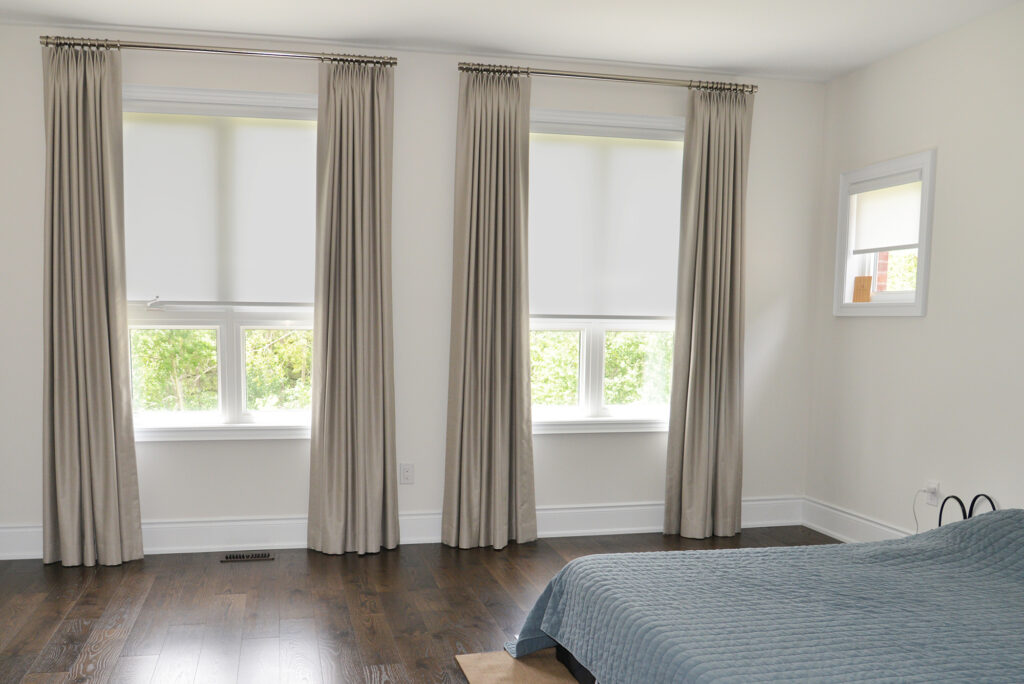
Where the brand calls for drapery, let the roller system carry the blackout performance and treat the drapery as décor.
Motorization for premium tiers
Motorized shades remove the chain from the guest’s hands entirely, let a room be set to a scene at check-in, and suit suites with large or hard-to-reach glazing. Sun Glow supplies Stealth and Somfy motors, both carrying a five-year warranty. The Motorization Guide covers power and control options and what to specify for new construction or a retrofit. Note that electrical hookups and runs are completed by others, so motorized floors need the electrician in the phasing plan.
Durability for Housekeeping Reality
Residential shades are operated a few times a day by someone who owns them. Hotel shades are operated by every guest, cleaned by every room attendant, and checked by every inspector.
Operating method
Loose chains are the first failure point in a guest room: pulled at angles, knotted, snagged by the vacuum. Chainless systems take that failure point away. Sun Glow’s NEO Chainless system and Zero Gravity provide a clean look with no dangling chains, and both reduce light gaps. Where chains are kept, all chain-operated Sun Glow roller shades now include the Safety Shield child safety device.
Cord safety is a regulatory question as well as a durability one. Health Canada’s guidance places products sold exclusively to commercial entities for commercial purposes outside the scope of the Corded Window Coverings Regulations. Whether a given hotel purchase falls inside or outside that scope is a question for your compliance advisor. Children stay in hotel rooms either way, and a cordless or motorized specification removes both the hazard and the question. For the full regulatory picture, see our breakdown of Canada’s corded window covering regulations.
Cleanable fabrics
Housekeeping will clean whatever is reachable with whatever is on the cart. Agree on a cleaning method for each fabric before ordering, put it in the housekeeping SOP, and make sure it matches the manufacturer’s care instructions. Many shade fabrics are spot-clean only, and harsh cleaners damage coatings. The Sun Glow Fabric Specification Chart is the place to start comparing fabrics before samples go to the model room.
Hardware and warranty
Specify commercial-grade aluminum heads, fascia and channels, and ask for cycle-life data on the operating system you choose. Sun Glow’s roller shades and Dual Shades carry a Limited Lifetime Warranty, and the motors carry their own five-year warranty. Ask any supplier how warranty claims are handled across a multi-floor property before you sign, not after the first failure.
Flame-retardant fabric
Hotels are public occupancies, and fabric fire performance is commonly required for window coverings in them. The two test methods most often named are NFPA 701 (Standard Methods of Fire Tests for Flame Propagation of Textiles and Films, current edition 2023) and CAN/ULC-S109 (Standard Method for Flame Tests of Flame-Resistant Fabrics and Films). Which one applies to your project, and at what level, is set by the authority having jurisdiction and your fire safety consultant.
Sun Glow’s range includes flame-retardant fabrics. Certification is a property of a specific fabric, not of a brand, so request the test documentation for each fabric on the schedule and file it with your submittals.
Procurement and Phasing
A hotel renovation rarely buys a building of shades at once. It buys a model room, then a floor, then the next floor, while the rest of the hotel stays open.
Start with the model room
Install the full specified system in a model room and inspect it at night and at midday with the lights off. That is where a sill leak or a clashing fascia should show up, and where the flag’s design team signs off. Change the spec there, once, rather than on forty floors.
Order by floor, verify by window type
Guest room floors repeat, but not perfectly. Corner rooms, accessible rooms and suites often have different glazing. Build the window schedule by window type and room type, then release orders floor by floor so each delivery matches the renovation sequence and nothing sits in a corridor waiting for trades. With Sun Glow’s commercial project support, every project is managed by a dedicated project coordinator from day one. Sun Glow’s own installation crew works with project managers to deliver, install and configure the product, and section detail drawings show how the system integrates into the building.
Ask early how long production and installation take for your quantities and floor sequence, and get the answer in writing against your renovation schedule. Lead times on a phased hotel job are a scheduling input, not a sales promise. Build float around them.
Attic stock and fabric continuity
A hotel will replace damaged shades for years after the renovation closes. Two things protect the look of the floors: attic stock, which is spare complete shades or fabric for the most common window sizes, held on site; and fabric continuity, which means confirming with the manufacturer how long a fabric and colour are expected to remain available and how dye-lot variation is handled on later orders. Settle both in the purchase agreement. For a deeper look at running replacement as a standing program, see the property managers’ guide to window covering replacement programs.
Punch lists and remakes
Every punch list has a few wrong shades. Agree before the first floor how remakes are reported, who re-measures, and how they are scheduled around occupied rooms.
Planning a guest room renovation? Request a quote with your room count and window schedule.
Brand Standards for Hotel Window Treatments
Flag standards are proprietary and vary by brand and tier, but the window treatment requirements fall into a predictable set of categories.
- Light control in guest rooms: blackout performance, often checked as visible light at the perimeter rather than through the fabric.
- Operating method: whether chains or cords are permitted, and where motorization is expected by tier.
- Fire performance: fabric test documentation to the standard the property requires.
- Finish and appearance: fabric colour as seen from the street, head treatment, and consistency across floors.
- Integration: how motorized shades connect to room controls or building systems.
Ask for the documentation package before the model room, not after it. From Sun Glow, that includes section detail drawings, the architectural binder covering dimensional limits, light gaps, mounting details and LEED criteria for each system, and the Fabric Specification Chart. Request fabric-level fire test documentation alongside them.
FAQ
What blackout percentage do hotels require?
Requirements vary by brand and tier, and flag standards are proprietary. Audits look at whether light is visible in the darkened room, which depends more on gaps at the sides, top and sill than on the fabric’s rating.
Do hotel blackout shades need side channels?
For guest rooms that must pass a blackout audit, usually yes, together with a bottom channel and a cassette or fascia. Without them, an opaque fabric still leaks light around its edges.
What window treatments last longest in hotels?
Systems with chainless or motorized operation, commercial-grade aluminum hardware and fabrics matched to housekeeping’s cleaning method.
How do hotels phase window treatment replacement?
Approve a model room, build the window schedule by window type, then order and install floor by floor. Agree attic stock, fabric continuity and remakes in the purchase agreement.
Do hotel window coverings need fire-rated fabric?
Commonly, yes. NFPA 701 and CAN/ULC-S109 are the usual test methods; the authority having jurisdiction sets what applies. Request test documentation for each fabric.
Blackout that passes the audit starts with the system, not the fabric. Send your room count and window schedule for a quote, and a Sun Glow project coordinator will work through the model room and the floor sequence with you. Request a Quote