If you've watched an installer measure a bay window and wondered whether the margins are as good as they look, you're asking the right question.
The decision to become a window covering dealer is really a decision about a business model: high-margin custom product, almost no inventory risk, and a manufacturer doing the hard part. This guide lays out the honest economics of running a window covering dealership in Canada in 2026 — what it costs to start, what you can realistically earn, what a manufacturer partnership actually includes, and how to tell a good supplier from a bad one. No income guarantees, no franchise fees — just the numbers and the mechanics.
The window covering dealer business model
The value chain is short and it works in your favour: a manufacturer makes custom product to order, a dealer measures, sells and installs, and the homeowner or commercial client pays for a finished, fitted result. You never guess a size, never stock a warehouse, and never eat dead inventory. Every order is made because a customer already said yes.
That structure is why custom window coverings carry a healthier margin profile than most stocked retail products. Gross margins on custom blinds and shades commonly land in the 40–50% range once you're comfortable quoting — the value is in the fit and the fitting, not the raw fabric. Average ticket sizes vary with the home, but whole-home jobs frequently run several thousand dollars, and motorization pushes that higher.
Compare that to selling boxed, in-stock product: you compete on price, you carry the inventory, and you discount to move it. Custom lets you compete on expertise instead. It's the difference between running a shop and running a service that happens to sell a product. You can browse the full custom window covering product line to see how broad the category is — roller and solar shades, romans, cellular, drapery, shutters and motorized systems.
Set honest expectations, though. This is a sales-and-service business: you win jobs by showing up, measuring accurately, and following through on installs. The margin is real, but it rewards operators who treat it like a trade, not a side hustle.
Shop-at-home vs. showroom vs. trade add-on
There are three proven ways in, and they differ mostly in overhead:
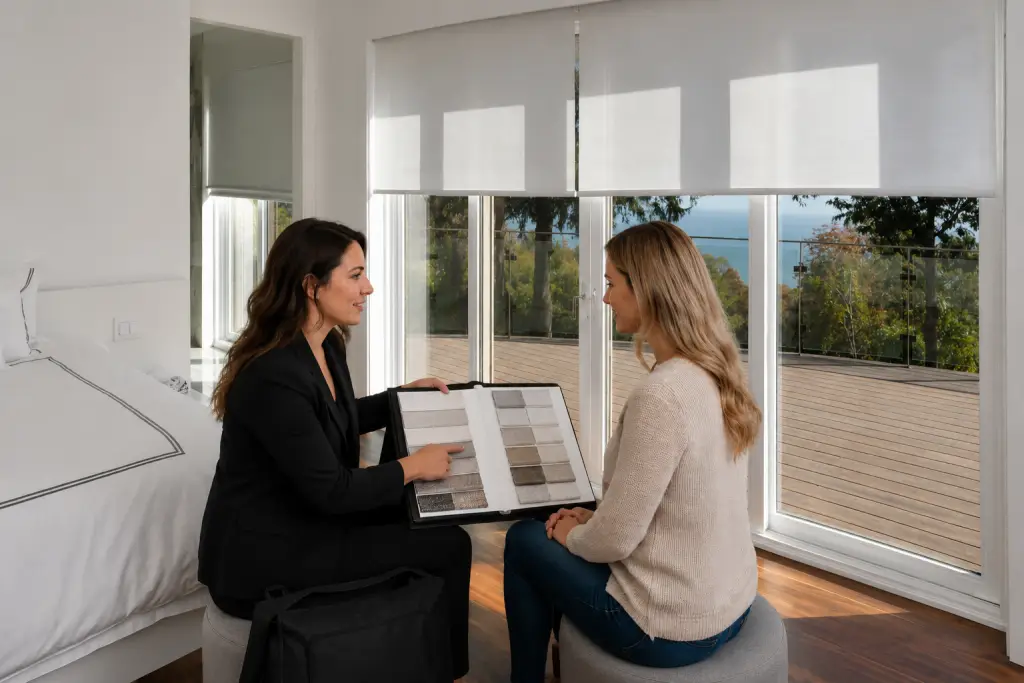
- ✦Shop-at-home (mobile). Sample books in the car, quotes in the customer's living room. Lowest cost, fastest start, and the model most new dealers begin with.
- ✦Showroom. A physical space with working displays. Higher overhead, but it builds trust and attracts walk-in and design-trade business.
- ✦Trade add-on. An existing flooring, paint or décor retailer bolting window coverings onto an established customer base — often the highest-ROI entry of all.
What you need to start
Startup cost depends almost entirely on which model you choose. Below are illustrative ranges for each — switch between them to compare. These are planning estimates, not quotes; your real numbers will vary by region and how much you already own.
Illustrative ranges for planning only — confirm current figures with your Sun Glow dealer manager.
What a manufacturer partnership provides
A good dealer program removes most of the reasons people hesitate. Here's what Sun Glow puts behind you, concretely — not as a brochure, but as the operating kit you actually use.
Samples & displays
Current sample books, fabric cards and working displays so customers can touch, feel and decide with confidence.
Training & onboarding
Product knowledge, measuring technique and quoting — plus a named dealer manager you can actually reach.
Portal ordering
Quote, order and track every job in one place — pricing and lead times built in, no back-and-forth by email.
Marketing support
Brand assets, product imagery and co-marketing material so your storefront looks established from day one.
Samples & displays
Selling custom is a tactile business. You get current sample books and display units kept up to date as the line evolves, so you're never quoting from a discontinued swatch. For showroom and trade dealers, working motorized demos do a lot of the selling for you.
Training & onboarding
You don't need a window-covering background to start — you need to measure accurately and quote confidently, and both are teachable. Onboarding covers the product families, how to measure inside- and outside-mount, and how to price a job so it's profitable. Experienced installers ramp faster; newcomers get there with reps.
Portal ordering workflow
The online dealer ordering portal is the operational backbone of the business. You build a quote from real-time pricing, convert it to an order, and track production and shipping without a single phone call. Fewer errors, faster turnarounds, and a clear record of every job.
Marketing support
You get the brand assets, product photography and co-branded material to look established from your first week — plus the credibility of a manufacturer that's been Canadian-made since 1983. Want the specifics? See what's in the dealer program.
A worked first-year P&L
Here's a realistic first year for a mobile dealer, with a natural ramp as your pipeline builds. Adjust the assumptions below and the numbers update. Every input is labelled — these are illustrative figures to think with, not a forecast.
Assumptions: jobs ramp from ~25% of maturity in month one to full run-rate by month nine; gross margin = 100% − COGS; overhead covers vehicle, insurance, samples, software and marketing. Illustrative example — verify with your own market and your Sun Glow dealer manager. Not an income guarantee.
This is the moment the business gets real. If the math works for your market, the next step is simple — apply to become a Sun Glow dealer. For pricing depth, see our guide on how to price custom window treatments.
How ordering works: from quote to installed window
Because Sun Glow manufactures in Toronto, the timeline is measured in days, not weeks — no overseas queue, no border friction. Here's the path every job takes. You can read more on how custom blind lead times work.
Two weeks, start to finish, is a realistic round trip on a typical order — and you collect on completion. That velocity is the quiet advantage of buying from a Canadian manufacturer instead of importing.
8 questions to ask any manufacturing partner
Whoever you partner with, ask these before you sign. We've noted how Sun Glow answers — hold every supplier to the same standard, and talk to our dealer team if you want ours in writing.
How Sun Glow's dealer program works
No franchise fee, no buy-in, no lock-in. The path from interested to installing is short and human — here's exactly what happens.
A short application about your market and how you plan to sell. Takes a few minutes.
A real call with our dealer team — your questions, our terms, no pressure.
Samples ship, portal access is set up, and training is scheduled — typically within about two weeks.
You're live: measure, quote in the portal, order, install, get paid.
Common questions
How much do window covering dealers make in Canada?+
It depends on volume and model, but with 40–50% gross margins a busy mobile dealer can build a healthy owner-operator income within the first year. Use the calculator above to model your own market — it's illustrative, not a promise.
Do I need experience to become a blinds dealer?+
No. Many successful dealers come from décor, flooring, paint or general contracting — or start fresh. Onboarding teaches measuring and quoting; a handful of jobs builds the confidence.
How much does it cost to start a window treatment business?+
A mobile shop-at-home start is often $1,500–$6,000. A showroom is a bigger commitment ($20,000+). A trade add-on for an existing retailer can be under $5,000. See the startup-cost tables above.
Does Sun Glow require minimum order volumes?+
No. There's no minimum order quantity and no annual volume commitment to stay an active dealer. You order what your customers buy.
How long does dealer onboarding take?+
From approval to quoting is typically about two weeks — the time it takes to ship samples, set up portal access and complete training.
Can I sell Sun Glow products online?+
Custom window coverings need accurate measurement, so most selling is consultative. We'll talk through appropriate online lead-generation and how it fits our channel approach during your onboarding conversation.
I came from flooring and added blinds as a side line. Two years in, it's half my revenue and the highest margin thing I sell. The portal and the lead times are what make it work.