On a condo project, window coverings get decided by default more often than by design. Nobody owns them until a purchaser asks at the decor centre, a deficiency list shows bare glass at PDI, or a facade review finds forty different blinds facing the street.
This guide covers the condo window coverings builder questions that come up on every multi-residential job: which program model to run, what to standardize, how pricing behaves at unit scale, how installs fit around occupancy, and who answers the warranty call two years later.
The market context matters. BILD reported 215 new condominium apartment sales across the GTA in August 2026, 78 per cent below the 10-year average, with 12,734 condo units still in inventory (BILD / Altus Group, September 22, 2026). When suites take longer to sell, finish packages and decor-centre upgrades carry more weight in the pitch, and a coverings program that runs cleanly at closing is one less thing to go wrong.
The Three Program Models
Coverings sit awkwardly between developer-supplied amenity and purchaser upgrade. Most projects resolve that tension with one of three models, and the choice drives everything downstream.
Developer-standard include
The developer specifies one product, fabric and control per suite type and installs it in every unit before closing. Purchasers get a finished suite, and the building gets a uniform face to the street. The developer carries the full cost and the full deficiency exposure.
Purchaser upgrade program
Coverings are offered as an extra. Purchasers choose from a curated range, pay for their selection, and the order is placed suite by suite. The developer carries little cost, but the facade becomes whatever purchasers chose, and suites that skip the upgrade close with bare glass.
Decor-centre partnership
A hybrid. A base product is included or offered, and the decor centre sells upgrades from a sample wall supplied by the manufacturer. Orders flow suite by suite into one production and install schedule. It needs a supplier that can train decor-centre staff and track hundreds of individual selections.
| Model | Who pays | Facade consistency | Admin load | Main risk |
|---|---|---|---|---|
| Developer-standard include | Developer | Highest — one spec per suite type | Low: one order, one schedule | Cost carried on every suite, including unsold ones |
| Purchaser upgrade program | Purchaser | Lowest — varies suite to suite | High if tracked by hand | Bare-glass suites at closing; mixed exterior view |
| Decor-centre partnership | Split, by selection | Controllable — set a common outward colour | Moderate, if the tracking tool is real | Selections lost between decor centre and production |
One way to keep the facade under control in the upgrade models: fix the colour that faces the street. On a City of Toronto supportive housing project, Sun Glow used colour-coordinated fabrics facing outward to keep the building’s exterior uniform. Purchasers can still vary what faces the room.
Product Selection: Condo Window Coverings Every Builder Can Standardize
Condo glazing is wide, often floor to ceiling, and repeated hundreds of times. The product has to survive that repetition, not just look right in the model suite.
Zebra and solar roller shades
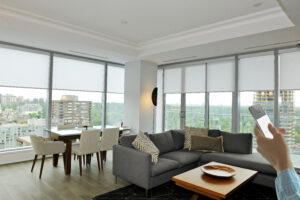
Two products cover most condo suites. Roller shades in a sunscreen fabric cut glare in living areas, with a blackout fabric in bedrooms; McMaster’s new residence used exactly that split, sunscreen and blackout in the same building. Zebra shades for condo glazing suit purchasers who want daylight and privacy from one shade: Sun Glow’s Interlude line uses alternating sheer and solid bands and is listed for both residential and commercial applications.
Wide glass and continuous walls
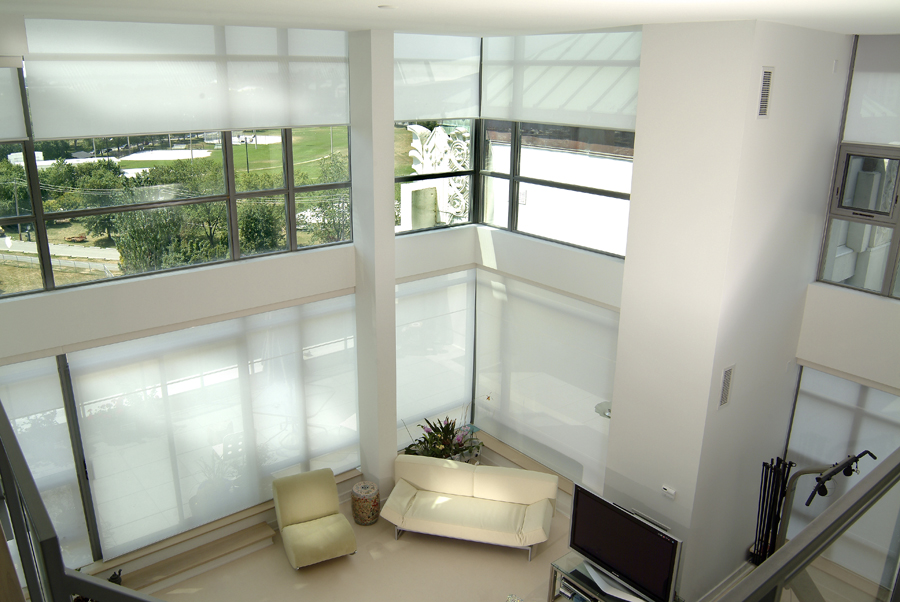
A wall of floor-to-ceiling glass is rarely one shade. Splitting it at mullions keeps each shade manageable and keeps a single failure from darkening a whole wall. Interlude’s Multi-in-One option combines several shades under a single headrail, which keeps a split wall reading as one treatment. Wide shades also need the tube and bracket confirmed for the span at shop-drawing stage, not on site. Ask the manufacturer to check every width against its limits before the order is released.
Headrail and finish
A cassette hides the roll and gives every suite the same finished line at the head. Sun Glow’s Square Cassette is delivered fully assembled and works with its chainless controls (NEO Chainless, NEO EZ Pump and Zero Gravity), which matters when a crew is installing hundreds of them.
Cords and compliance
Blinds supplied in a new suite are consumer products supplied to a purchaser, so Canada’s corded window covering regulations apply to every unit. The simplest standard is cordless across the building: Zero Gravity spring operation balances the shade’s weight so it moves with a light touch, and motorization removes the operating cord entirely. Where chain operation is specified, every chain-operated Interlude shade now includes Sun Glow’s Safety Shield child safety device. Ask for test evidence on the exact configuration you are buying, from any supplier.
Pricing Logic at Unit Scale
This section gives structure, not numbers. Program pricing depends on the project, and any figure published here would be wrong for yours.
Three things move the price of a condo program more than anything else.
- SKU standardization. Fewer fabric, width and control combinations mean fewer setups and fewer mistakes. A building with three suite types and one fabric family prices differently from one with forty purchaser selections.
- Volume and certainty. A committed unit count lets the manufacturer plan production. A program priced per suite but released one sale at a time behaves more like retail.
- Phased delivery. Delivering floor by floor to the construction schedule avoids on-site storage and damage, but every extra trip is a cost. Agree the number of release phases at the start.
If you are weighing an upgrade or decor-centre model, see the builder portal for how selections are tracked. Two smaller items catch developers out: who pays for check measures when drywall or window frames change after the first measure, and what happens to selections for suites that never close. Settle both in the program agreement.
Installation Around Occupancy
Coverings are one of the last trades in a suite and one of the first things a purchaser sees. Timing them is the hardest part of the program.
Measure after the glass and frames are final
Measure too early and every adjustment to drywall returns or sill details becomes a remake. Sun Glow’s installation service runs a check measure before production and replaces any shade it mismeasured at no additional cost. Whoever measures, put that guarantee in writing.
Install by floor, ahead of PDI
Tarion describes the Pre-Delivery Inspection as a builder-led walkthrough that records items that are incomplete, damaged, missing or not operating properly before the purchaser takes possession. A shade installed before PDI is a shade the purchaser inspects. A shade installed after PDI is an extra visit to an occupied suite. For included programs, plan installs floor by floor so each floor is complete before its PDI dates.
Site logistics
Book the service elevator for delivery and install days. Get floors cleared of other trades’ material before the crew arrives. Sun Glow’s installation terms are typical of what to expect: site conditions must be safe and accessible, moving obstructions such as scaffolding is extra, heights over 10 feet are quoted separately, and electrical hookups for motorized shades are done by others. Plan for each of these in the schedule rather than discovering them on install day.
Deficiencies
Agree one deficiency workflow before the first floor: who logs the item, who confirms it is the shade and not the frame, and how fast a replacement ships. Sun Glow brings product directly from production to site and gets customer sign-off on completion, which gives both sides a record of what was handed over.
Warranty and Service at Scale
Two years after occupancy, the purchaser calls the property manager, who calls the developer. The program should already say who answers.
- One counterparty. Have the manufacturer that made and installed the shades hold the product warranty directly, rather than routing claims through an installer who may no longer be on the project. Sun Glow’s Interlude zebra shades carry a Limited Lifetime Warranty; confirm terms for each product you specify.
- Attic stock. Agree a quantity of spare fabric or complete shades per suite type, stored on site, so a damaged shade can be swapped before the purchaser notices the facade gap. Record the fabric and colour reference with it.
- Post-occupancy service. Purchasers who want to change or add coverings later need a route that isn’t the developer’s site office. Give the condo corporation the supplier’s contact and the suite-type spec at turnover.
When the building moves into ongoing management, the same spec becomes the base for a replacement program for multi-unit buildings. Handing it over cleanly saves the property manager from rebuilding it.
Working With Sun Glow’s Builder Program
The SG Builder Program is built for decor-centre and multi-suite orders: samples, staff training, a unit-by-unit ordering system, and Sun Glow’s own measuring and installation.
The program’s ordering system, ShadeQuote Pro, lets decor-centre staff customize, quote and order shades for each purchaser suite by suite. It tracks units sold, shade purchases, units reviewed with customers, unsold units and units pending review, so the developer can see where every suite stands. Sun Glow supplies the physical samples and a custom fabric catalogue for the decor centre and trains the design team.
On contract projects, a dedicated project coordinator manages the job from day one, and Sun Glow produces section detail drawings showing how the product integrates with the building. Product is designed, tested and manufactured in-house.
In one program described on the Sun Glow builder portal page, a builder added Sun Glow shades to its design-centre offering across two condo developments. Sun Glow supplied the sample wall, trained the design team on the product and ShadeQuote Pro, manufactured every shade at its East York factory, measured each window and installed every shade. Residents moved into finished suites.
If you are earlier than that, at budget or massing stage, start a builder program conversation before the finish schedule is locked.
Suite 101 to the penthouse, one supplier, one warranty. Book a consultation and we’ll structure a program around your occupancy schedule. Book a Consultation
FAQ
Do developers supply window coverings in new condos?
Some do and some don’t. Developers either include a standard product in every suite, offer coverings as a purchaser upgrade, or run a hybrid through the decor centre. Included programs give the most consistent facade; upgrade programs shift cost to purchasers but leave some suites bare at closing.
How do builder blinds programs work?
The manufacturer supplies samples and trains decor-centre staff, purchasers choose from a curated range, and selections are tracked suite by suite into one production and install schedule. The manufacturer measures each window once frames are final and installs floor by floor ahead of closing.
What blinds suit floor-to-ceiling condo windows?
Zebra shades and roller shades in sunscreen or blackout fabric cover most condo suites. Wide walls are usually split at mullions, and every width should be checked against the manufacturer’s limits for tube and bracket before ordering. A cassette gives a consistent finished head across the building.
When are blinds installed in a new condo build?
For included programs, after final measure and before the Pre-Delivery Inspection, so the purchaser inspects a finished suite. Upgrade orders placed late may install after occupancy, which means booking access to occupied suites.
Who handles blind warranties in a new development?
Whoever the program agreement names. The cleanest arrangement makes the manufacturer the single warranty counterparty for every suite, backed by attic stock on site and a service contact handed to the condo corporation at turnover.